
COLLABORATION toolkit
Project Sites
This toolkit builds on the work of nine project sites that took part in the State Justice Institute's County, Court, and Justice Leaders initiative. At each site, county leaders, courts, justice system partners, and community-based organizations worked together to plan system-level change in their communities.
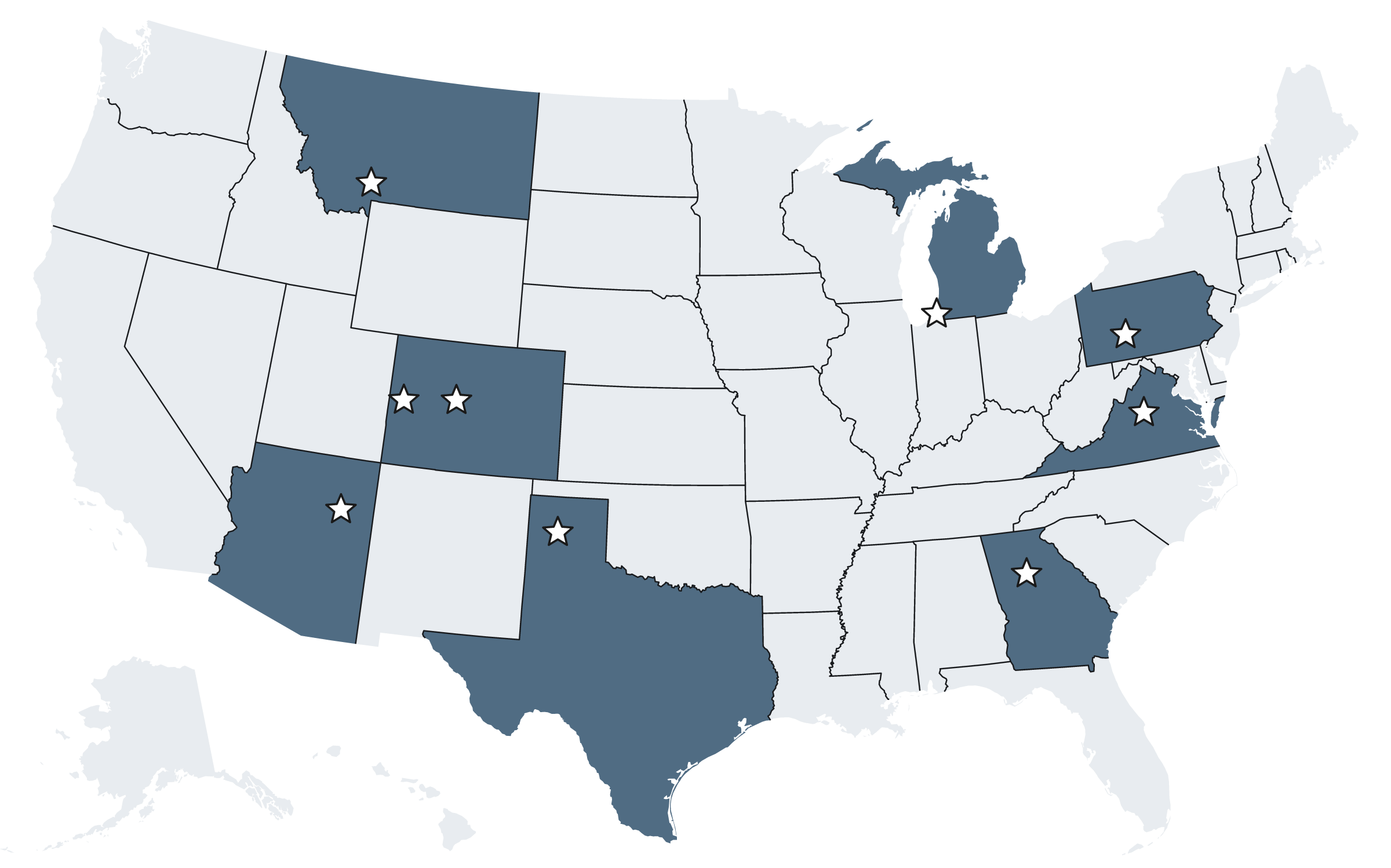
Their work focused on community violence and gaps in access
to mental health and substance use treatment. The sites' plans, data, and lessons learned shaped the modules in the toolkit, and many of them are featured in the toolkit's videos and resources. We are grateful for the time, candor, and commitment each team gave to this work.
Virginia
Albemarle County and City of Charlottesville
Built a regional criminal justice strategic plan to improve jail-to-community transitions, expand diversion, reduce stigma, and improve access to mental health and substance use care.
Michigan
Berrien County
Improved services for youth through a new juvenile justice facility, early intervention, wraparound services for youth and families, and diversion programs.
Pennsylvania
Cambria County
Improved how justice, public safety, and treatment agencies collected and shared data, with priorities in recovery housing, reentry, court diversion, and trauma-informed services.
Montana
Gallatin County
Built a data-driven roadmap on existing behavioral health partnerships, with plans for treatment court access, mobile crisis services, and jail reentry support.
Colorado
Lake County
Developed a community justice plan to improve access to services and their quality, using shared data to guide policy, reduce crime, and lower justice system costs.
Colorado
Mesa County
Identified policy and practice gaps to reduce jail use among people with mental health and substance use disorders and to build community trust, using surveys, focus groups, and peer networks.
Arizona
Navajo County
Used its Criminal Justice Coordinating Council (CJCC) to coordinate treatment providers and the justice system, expand law enforcement and court diversion, and improve communication among members.
Pennsylvania
Potter County
Created a data-driven roadmap to unify county justice efforts, including an aftercare program to support people leaving jail and reduce recidivism.
Georgia
Rockdale County
Worked to ease jail capacity pressure through better coordination and data sharing across systems, continuity of care for people with mental health and substance use disorders, and long-term sustainability planning.